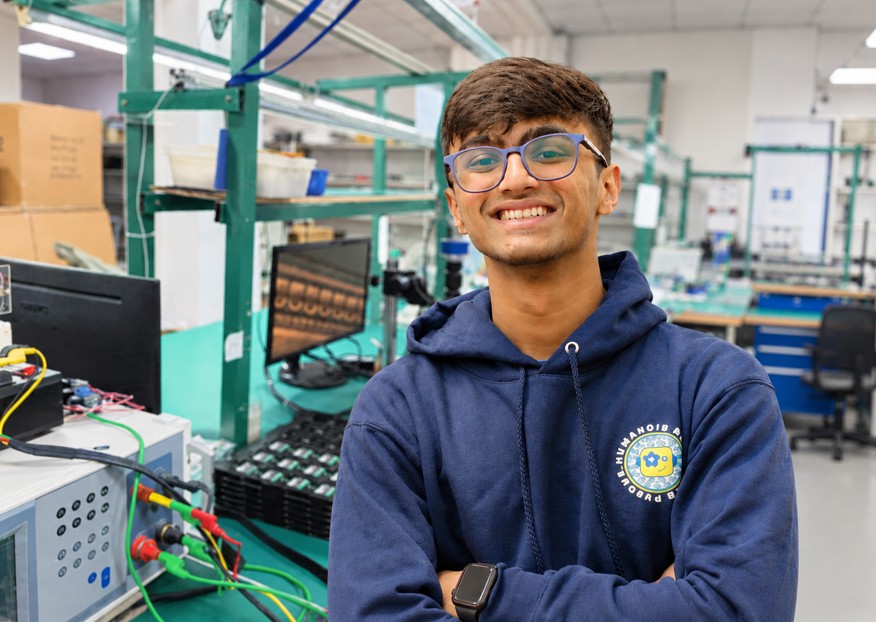
Hyderabad, October 25, 2026: In an industry obsessed with high-resolution displays and relentless screen time, 20-year-old Aarav Garg is building a world where hardware fades into the background.
As Chief Hardware Officer and founding team member at Persona, the Purdue-educated engineer is steering the startup’s flagship product—the Persona Band—from initial CAD designs to production lines in China. The screenless, voice-enabled wearable aims to integrate personal AI into daily routines without forcing users to stare at another glass rectangle. With shipments targeted for December 2026, the team is entering the most punishing phase of consumer electronics: transitioning from working engineering units to reliable mass manufacturing.
Weighing just 27 grams, the hardware discards visual interfaces entirely. Interaction relies on a dual-microphone array, a custom speaker, and an ambient 12-LED ring that communicates status. Underneath the minimal casing of Persona band sits a component stack designed to deliver up to five days of battery life while handling real-time voice processing across more than 120 languages.
Striking that balance almost meant stripping out audio output altogether.
“We initially planned to leave the speaker out of V1 because of the space and power constraints,” Garg says. “But we realised that the experience would feel incomplete if users could speak to the Band and then had to turn to their phone for a response. Adding a speaker closes that interaction loop on the device itself. We decided that experience was worth the additional engineering and manufacturing complexity, even though it made the product considerably harder to build.”
Integrating a speaker module alongside dual microphones and an extended-life battery inside a sub-30-gram chassis required rebuilding internal architecture from scratch, including custom-pouching a battery tailored specifically to the internal volumetric envelope.
The mechanical design posed its own set of tolerance hurdles. “We’ve radically simplified the design so that switching straps—and even putting the Band on or taking it off—feels effortless,” Garg notes. “Taking that from prototype to production has been a mountain of learning: understanding how each material, mechanism, and assembly process behaves, then working through the challenges one by one.”
Moving from functional prototypes to consumer-ready volumes is where physical products live or die. Garg is currently managing sample production runs alongside manufacturing partners, putting the hardware through aggressive stress tests to establish baseline yield reliability.
Waterproofing the ultra-compact housing has proven particularly challenging. Quality verification protocols include submerged hydrostatic testing to confirm seal integrity, paired with automated mechanical rigs cycling the physical tactile button 10,000 times to map actuation decay before final mass-production sign-off.
At 20, Aarav Garg Drives Hardware Strategy for Wearable AI Startup’s Persona Band
“The design has been validated, and our focus now is on testing those units rigorously to identify and resolve any remaining failure points before the first mass-production run,” Garg says.
Garg’s entry into hardware predates Persona. After building custom robotics as a kid and studying engineering at Purdue, he co-founded Omi, another wearable AI startup, before bringing that hardware playbook to Persona.
The wristband serves as the initial physical touchpoint for a larger contextual intelligence stack. While the hardware prepares for its December debut at $179, the underlying assistant architecture is already operating in a public beta via iMessage, orchestrating calendars, travel logistics, and notes through natural language.
The hardware roadmap is supported by a recent $10 million funding round led by Vine Ventures, alongside Cory Levy and Collective Global, valuing the company at $100 million.
For Garg, delivering the first batch of wristbands is simply establishing the baseline hardware layer. “Over the next 12 months, we’ll iterate quickly on the Band and keep improving both the technology and the product,” he says. “The Persona Band is only the beginning: we already have additional hardware form factors planned internally, and we intend to keep expanding what we build around that intelligence.”
Persona Band, Aarav Garg, Wearables, Artificial Intelligence, Hardware Engineering, Tech Startups, Consumer Electronics, Screenless Tech